
Serpentina
Rauvolfia serpentina (L.) Benth. ex Kurz
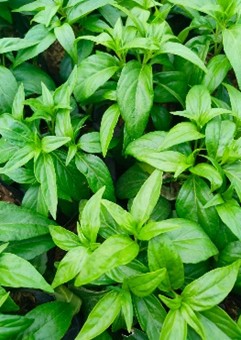
Description
Serpentina is a small evergreen erect shrub with whorled branches and milky sap. Leaves are opposite, entire, oblong-elliptic, up to 30 centimeters long. Flowers are white, clustered in axillary cymes, with slender corolla tube and 5 spreading lobes. Fruit is a small drupe, shiny, black or purplShrubs to 1 m tall, erect, glabrous. Stems usually unbranched, slender, straw colored. Leaves grouped near stem apex, in whorls of 3-5; petiole 1-1.5 cm; leaf blade narrowly elliptic or obovate, membranous, 7-17 X 2-9 cm, base cuneate, apex acuminate or rarely obtuse; lateral veins 7-15 pairs. Cymes congested; peduncle 5-13 cm, red or reddish. Pedicel and calyx red or reddish. Corolla white, tube cylindric, 1-1.8 cm, inflated at middle and pilose inside distal half; lobes obliquely suborbicular, 1.5-3.5 mm. Stamens inserted at middle of corolla tube. Ovaries connate in basal half. Drupes ellipsoid, ca. 8 mm, connate for half their length. (Flora of China)
Uses
- Stimulant for uterine contractions
- Insomnia
- Insanity
- High blood pressure
- Antidote to poisonous reptiles and insect bites/stings
- Mental disorders
- Headache
- Dysmenorrhea
- Epilepsy
- CNS depressant effect
- hypnotic
- anxiety
- paranoia
- nervousness
- amenorrhea
- oligomenorrhea
- dysmenorrhea-like abnormalities
- hysteria
- epilepsy
- treatment of AIDS
- splenic diseases
- asthma or respiratory problems
- scabies
- used for treatment of itches, boils, and eczema
- malarial fever
Plant Part Used
Roots
Distribution
- Introduced to the Philippines
- Native to Andaman Is., Assam, Bangladesh, Cambodia, China South-Central, East Himalaya, India, Jawa, Laccadive Is., Laos, Lesser Sunda Is., Malaya, Myanmar, Nepal, Sri Lanka, Thailand, Vietnam
- An endangered species due to overexploitation and extraction of roots
- Considered critically endangered species by the IUCN
Preparation
- Root power given with equal amounts of Triphala powder twice daily is used for hypertension and associated headache and giddiness. Root powder given for amenorrhea, oligomenorrhea and dysmenorrhea-like abnormalities. For snake bites and scorpion bites, root powder mixed with Piper cubeba and salt applied externally to the bite as well as taken internally
- Root decoction used for treatment of headaches. Also used for treatment of AIDS and splenic diseases. Fresh leaf juice applied to prevent eye inflammation. Fresh root juice or dried root powder soaked in water used orally for asthma or respiratory problems. Root juice mixed with leaf juice of A. paniculata and Nyctanthes arbortristis used for treatment of scabies. Root paste used for treatment of itches, boils, and eczema.
- Root and leaf paste, made into pills and sundried, used to treat malarial fever. Mixture of root paste and black pepper used for malaria. Mixture of leaf juice with Andrographis paniculata and Azadirachta indica with honey used for treatment of malaria
- Herbal Tea (Decoction)
- How to make: Boil fresh or dried serpentina leaves in water (typically simmering the leaves for a few minutes until the water turns yellowish or bitter).
- Use: Traditionally consumed in small amounts to help lower blood sugar, manage hypertension, or relieve colds and fever. Because of its intense bitterness, it is often drunk plain or with a natural sweetener
References
- https://www.stuartxchange.org/Serpentina.html
- https://www.google.com/search?q=medicinal+preparation+for+serpentina&oq=medicinal+preparation+for+serpentina&gs_lcrp=EgZjaHJvbWUyBggAEEUYOTIHCAEQIRigATIHCAIQIRigATIHCAMQIRigATIHCAQQIRifBTIHCAUQIRifBTIHCAYQIRifBTIHCAcQIRifBTIHCAgQIRifBTIHCAkQIRifBdIBCjE5OTE1ajBqMTWoAgiwAgHxBRcaQrIGQV7l8QUXGkKyBkFe5Q&sourceid=chrome&source=chrome.rb&ie=UTF-8