
Samsamping/pukingan
Clitoria ternatea Linn.
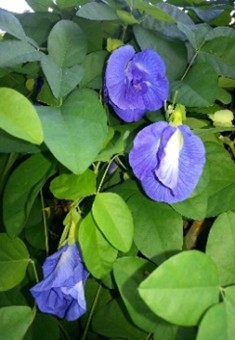
Description
Pukiñgan/samsamping is a twining herb or climbing vine with cylindrical and slender stems, sometimes up to 1 centimeter in diameter. Leaflets are 5 to 7, elliptic to oblong, 3 to 7 centimeters in length. Stipes are small and acicular. Flower is solitary. Calyx is green, about 1.5 centimeters long. Corolla is 3.5 to 4 centimeters long, with the standard deep blue with a white, yellowish, or pale-blue center. Pods are 5 to 10 centimeters long, flat, with 6 to 10 seeds.
Uses
- anthelmintic
- remove phlegm in chronic bronchitis
- Swollen joints
- Earache
- Laxative
- Purgative
- Expectorant
- Urethral irritation
- Hiccups
- Asthma
- Throat and eye infection
- Aphrodisiac/sexual enhancer
- Migraine
- Memory enhancer
- induce nausea and vomiting
- demulcent for bladder and urethral irritation
- cathartic
- skin diseases
- hasten delivery
- facial care
- jaundice
- treat mental disorders and to relieve stress
- boils
- antidepressant
- anti-stress, anxiolytic, sedative, anti-arthritic, and anticonvulsant
- bleeding uterine disorders
- abdominal swellings, sore throat and nervous disorders
- scabies
- fever
- urinary tract infections, lack of urination, and frequent urination
- edema
- snake bite
- tumor
- indigestion
- tuberculosis
- renal stones
Plant Part Used
Roots, leaves, flowers, seeds
Distribution
- Introduce to the Philippines.
- Throughout the Philippines, in thickets in settled areas at low and medium altitudes.
- Cultivated for its conspicuous blue flowers.
- Now pantropic
Preparation
- Warm leaf juice mixed with common salt is applied around the ears for earache
- Poultices of leaves used for swollen joints
- For hiccups, the seeds are burned for fume inhalation; same also used for asthma
- Root ash is used for facial care
- Juice of leaves mixed with green ginger used in cases of sweating in hectic fever
- Root juice, applied in the nose for migraine
- For painful boils, mix the root juice with vinegar and apply to the boils
- Leaf juice taken twice daily for 6 days for scabies
- Root-bark infusion used as demulcent for bladder and urethral irritation
- Alcoholic extract has been used as a cathartic
- To hasten delivery twinning branches of the white flowered variety are wrapped around the waist
- Root ash is used for facial care
- Root powder is used for jaundice
- Roots used to treat mental disorders and to relieve stress
- For renal stones, the roots used with boiled rice
- Roots and seeds used as diuretic and emmenagogue; also to induce vomiting
- Juice of leaves mixed with common salt is applied warm around the ear for earaches, especially when accompanied by swelling of the surrounding glands
- Root juice, applied in the nose for migraine
- For painful boils, mix the root juice with vinegar and apply to the boils
- Powdered flower mixed with honey for bleeding uterine disorders
- Roots used to induce abortion and its paste use to treat abdominal swellings, sore throat and nervous disorders
- Root infusion used as antidote against snake bites
- a teaspoon of root paste with black pepper is mixed in water and taken for leucorrhea
- root juice mixed with milk and taken orally to treat gonorrhea and cold
- Paste nuts used to treat leprosy and enlargement of the limbs
- Root infusion used as antidote against snake bites
- Leaf extracts used to treat catarrh and headache
- leaves and roots used for urinary tract infections, lack of urination, and frequent urination
- root decoction for fever, tuberculosis, and constipation