
Pallang/sigarilyas/winged bean
Psophocarpus tetragonolobus (L.) DC.
Description
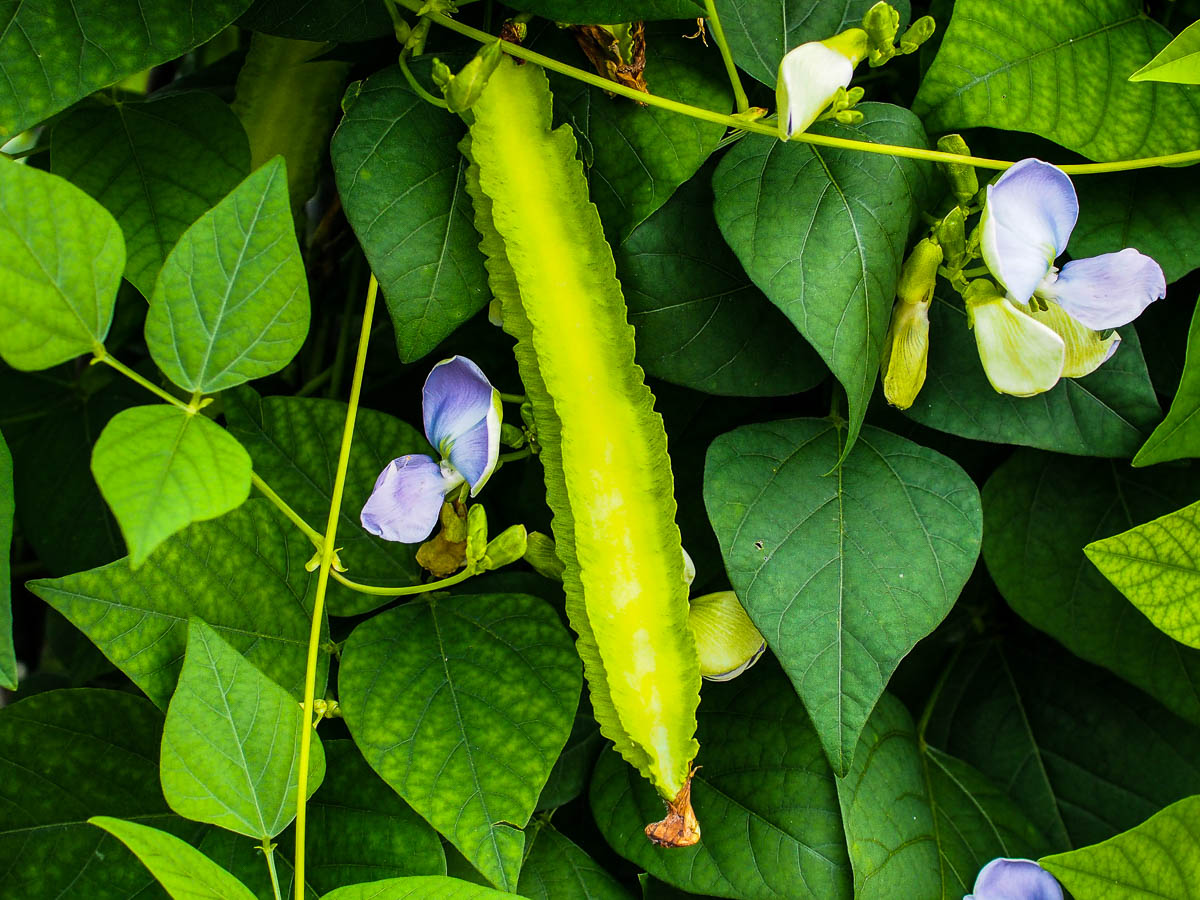
Winged bean plant grows as a vine with climbing stems and leaves, 3–4 m (10–13 ft) in height. It is an herbaceous perennial, but can be grown as an annual. It is generally taller and notably larger than the common bean. Leaves can be 15 cm (6 in) long. Leaf shape ranges from ovate to deltoid, ovate-lanceolate, lanceolate, and long lanceolate; the green tone of the leaves also varies. Stem is most commonly green, but sometimes boasts purple. Flower is large and pale blue. Bean pod may be smooth or rough, depending on the genotype, typically 15–22 cm (6–8+1⁄2 in) long, rectangular in cross-section (though sometimes appearing flat), and has four wings with frilly edges running lengthwise. Skin is waxy and the flesh partially translucent in the young pods. Color of the pods may be cream, green, pink, or purple. When fully ripe, the pod turns an ash-brown colour and splits open to release the seeds (beans). Seed shape is often round; oval and rectangular seeds also occur. Seeds may appear white, cream, dark tan, or brown, depending on growing and storage conditions
Uses
- Seeds are about 35% protein and 18% fat,
- Good source of vitamins A and C, calcium and iron
Plant Part Used
Pods, leaves, flowers and roots
Distribution
- Introduced, naturalized.
- Cultivated, semi-cultivated, and occasionally spontaneous or subspontaneous in most parts of the Philippines at low and medium elevation
- Native to Tanzania.
Preparation
1. Leaf & Flower Infusions/Decoctions: In Southeast Asia, boiled leaf infusions are used as lotions for smallpox or as washes to treat skin inflammation and suppurating sores.
2. Leaf Paste: Applied topically to treat body swelling.
3. Seeds: Crushed seeds are used to treat tapeworm.
4. Tubers: These are typically boiled for over two hours to be consumed for their medicinal benefits.
5. Fresh Consumption: Young leaves, flowers, and pods can be eaten raw in salads to utilize their antimicrobial properties, which have been shown to combat Pseudomonas aeruginosa and Candida albicans.
6. Powder: Leaves are sometimes dried and powdered for inclusion in nutritional shakes.