
Sambong
Blumea balsamifera (Linn.) DC.
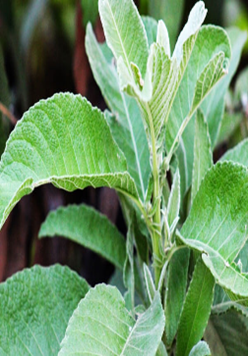
Description
Sambong is a half woody, strongly aromatic shrub, densely and softly hairy, 1 to 4 meters high. Stems grow up to 2.5 centimeters in diameter. Leaves are simple, alternate, elliptic- to oblong-lanceolate, 7 to 20 centimeters long, toothed at the margins, pointed or blunt at the tip, narrowing to a short petiole which are often auricled or appendaged. Flowering heads are stalked, yellow and numerous, 6 to 7 millimeters long, and borne on branches of a terminal, spreading or pyramidal leafy panicle. Discoid flowers are of two types: peripheral ones tiny, more numerous, with tubular corolla; central flowers few, large with campanulate corolla. Involucral bracts are green, narrow and hairy. Anther cells tailed at base. Fruits are achenes, dry, 1-seeded, 10-ribbed, hairy at top.
Uses
- Leaves as poultice for abscesses
- for fevers, kidney stones, and cystitis
- rheumatic pains of waist and back
- upper and lower respiratory tract affections like sinusitis, asthmatic bronchitis, influenza
- for wounds and cuts
- headaches, coughs
- menstrual cramps or dysmenorrhea
- cough, distended stomach, high blood pressure, and insomnia
Plant Part Used
Leaves (fresh or dried) and young roots before flowering. Mature, healthy, fully expanded leaves are harvested; old or damaged ones are discarded. Air-dry until brittle when crushed, then store in amber bottles in a cool, dry place.
Distribution
- Native to the Philippines.
- Common in open fields, grasslands and waste areas at low and medium altitudes.
- Flowering from February to April.
- Propagation by cuttings and layering.
- Also native to Andaman Is., Assam, Bangladesh, Borneo, Cambodia, China, Christmas I., Himalaya, India, Jawa, Laos, Lesser Sunda Is., Malaya, Maluku, Myanmar, Nepal, New Guinea, Nicobar Is., Pakistan, Sri Lanka, Sulawesi, Sumatera, Taiwan, Thailand, Vietnam.
Preparation
- Boil chopped leaves in water for 15 minutes until 1 glassful remains. Cool and strain divide decoction into 3 parts. Drink 1 part 3 times a day - Decoction of roots and leaves for fevers, kidney stones, and cystitis.
- Decoction of leaves used to induce diuresis for purpose of treating kidney stones.
- Sitz-bath of boiled leaves, 500 gms to a gallon of water, for rheumatic pains of waist and back.
- Used in upper and lower respiratory tract affections like sinusitis, asthmatic bronchitis, influenza.
- Applied while hot over the sinuses. Used for wounds and cuts.
- Fresh juice of leaves to wounds and cuts.
- Poultice of leaves applied to the forehead for relief of headaches.
- Use leaf infusion for the treatment of cough
- Tea is used for colds and as an expectorant; likewise, has antispasmodic and antidiarrheal benefits.
Postpartum baths:
- Tea leaves use as emmenagogue, for treatment of menstrual cramps or dysmenorrhea. As such, folklore advise against use during pregnancy or for women who want to get pregnant.
- Decoction of fresh leaves used for cough and influenza or as inhalation of vapour from boiling of leaves. - Poultices of pounded leaves applied to hemorrhoids; an alcoholic maceration used as liniment for rheumatism.
- 3% ethanol solution used to soothe itching.
- Leaves used for the treatment of urolithiasis.
- Dried leaves are chopped, made into cigarettes and smoked for treating sinusitis.
- For fever, leaves boiled and when lukewarm used as sponge bath.
- Decoction of roots used for fever.