
Alugbati
Basella alba Linn.
Description
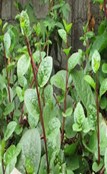
Alugbati is a succulent, branched, smooth, twining herbaceous vine, several meters in length. Stems are purplish or green. Leaves are somewhat fleshy, ovate or heart-shaped, 5 to 12 centimeters long, stalked, tapering to a pointed tip with a cordate base. Spikes are axillary, solitary, 5 to 29 centimeters long. Flowers are pink, about 4 millimeters long. Fruit is fleshy, stalkless, ovoid or nearly spherical, 5 to 6 millimeters long, and purple when mature.
Uses
- Common market product, a popular leafy and stew vegetable, and a good substitute for spinach.
- Excellent source of calcium and iron; good source of vitamins A, B, and C, with a high roughage value.
- Roots are employed as rubefacient.
- Poultice of leaves used to reduce local swelling.
- Sap is applied to acne eruptions to reduce inflammation.
- Decoction of leaves used for its mild laxative effects.
- Pulped leaves applied to boils and ulcers to hasten suppuration.
- Sugared juice of leaves useful for catarrhal afflictions in children.
- Leaf-juice, mixed with butter, is soothing and cooling when applied to burns and scalds.
- Used in hemorrhagic diseases and as tonic. Also used for burns and pruritic skin lesions.
- Leaves used for hypertension. In Cameroonian folk medicine, used for malaria
- Used for the removal of after birth, stomach pains, and increase milk production
- Herbal healers use plant extracts to enhance libido and as remedy for infertility.
Plant Part Used
Leaves, fruits, roots, stems
Distribution
Thailand, Vietnam.
- Found in settled areas, in hedges, old cultivated areas, etc., throughout the Philippines.
- Often cultivated.
Preparation
- Leaves applied to boils and ulcers to hasten suppuration. Leaf juice mixed with butter applied to burns and scalds for a soothing and cooling effect. Leaves and stems have been used as anticancer for melanoma, leukemia, and oral cancer.