
Roselle
Hibiscus sabdariffa Linn.
Description
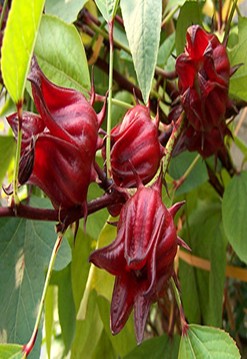
Roselle is an erect, branched, nearly smooth annual herb, 1 to 2 meters in height. Stems are purplish. Leaves are 8 to 12 centimeters long, variable in shape, entire or deeply 3- or 5-lobed, the lobes oblong to oblong-lanceolate. Calyx is somewhat hairy, lobes are pointed, connate below the middle, forming a fleshy cup. Corolla is pink with a dark center, about 5 centimeters long. Fruit is ovoid, pointed, hairy, about 2.5 centimeters long, enclosed by a fleshy and enlarged calyx.
Uses
- Used for the preparation of jellies
- Wine and other food products, sores
- Dysuria
- Dyspepsia
- Fever
- Nausea
- Antiscorbutic
- Diuretic
- Bronchitis
- Cough
- Boils
- Induce lactation
- Antihypertensive
Plant Part Used
Leaves and flowers
Distribution
Planted for ornamental purposes and its edible calyces, not spontaneous, introduce post-Spanish colonization, native of tropical Africa, now pantropic
Preparation
- Lotion made from leaves used for sores.
- Decoction of seeds used for dysuria and strangury; for mild dyspepsia and debility - drink made from the plant, considered refrigerant and used for fevers
- A boiled drink prepared from the fruit and calyx, dashed with salt, pepper, asafoetida and molasses, used for biliousness
- Heated leaves applied to cracks in the feet; also, to boils and ulcers to hasten healing and maturation
- Seed decoction used for dysuria, strangury and mild dyspepsia
- Seed decoction used to enhance or induce lactation in cases of poor milk production