
Lumboy/Duhat
Syzygium cumini (L.) Skeels
Description
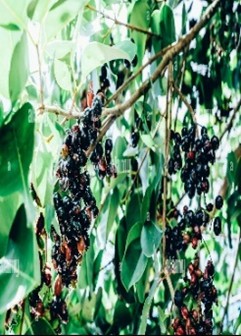
Duhat/Lumboy is a smooth tree, about 8 to 15 meters high with white branchlets and reddish young shoots. Leaves are opposite, shiny and leathery, oblong-ovate to elliptic or obovate-elliptic, 6 to 12 centimeters long, the tip being broad and shortly pointed. Panicles are borne mostly from the branchlets below the leaves, often being axillary or terminal, about 4 to 6 centimeters long. Flowers are small, numerous, scented, pink or nearly white, in clusters, without stalks, borne in crowded fascicles on the ends of the branchlets. Calyx is funnel-shaped, about 4 millimeters long, and 4-toothed. Petals cohere and fall all together as a small disk. Stamens are numerous and about as long as the calyx. Fruit is oval to elliptic, 1.5 to 3.5 centimeters long, dark purple or nearly black, luscious, fleshy and edible with a sweet astringent taste; containing a single large seed.
Uses
- Good source of calcium & iron
- Dysentery
- Diarrhea
- Gingivitis
- Wounds
- Diabetes
- Asthma
- Ulcer
- Sore throat
- Stomachaches
- Infections
- mouth ulcerations
- skin complaints
- metrorrhagia
- liver tonic
- enrich the blood
- strengthen the teeth and gums
- ringworm of the head
- tinea capitis.
- stomachic
- carminative
- diuretic
- indigestion
- appetite loss
- leucorrhea
- bronchitis
- asthma
- infectious diseases
Plant Part Used
Fruit and bark, seeds, leaves
Distribution
- Introduced into the Philippines.
- Found throughout the Philippines, planted, and in many regions spontaneous.
- Probably of prehistoric introduction from Malaya.
- Native to Andaman Is., Assam, Bangladesh, Cambodia, China South-Central, China Southeast, East Himalaya, Hainan, India, Jawa, Laccadive Is., Laos, Lesser Sunda Is., Malaya, Maluku, Myanmar, Nepal, Pakistan, Queensland, Sri Lanka, Sulawesi, Thailand, Vietnam. (25)
Preparation
- Decoction of bark given internally for dysentery
- Decoction of the bark used as a gargle or mouthwash for gingivitis and mouth ulcerations
- Pulverized dried seeds also used for diabetes
- Ripe fruit is astringent and considered an efficient remedy for diabetes.
- Decoction of leaves and bark also used for the same purpose, but the ripe fruit is considered the best
- Bark decoction also used as an enema.
- Diarrhea: Liberal amounts of the fleshy portion of the fruit.
- Fresh juice of the bark given with goat's milk for diarrhea in children.
- Leaves, bark and fruits used to treat infectious diseases, diabetes and stomachaches
- Poultice of leaves used for skin complaints
- Powdered seeds also used for metrorrhagia
- Bark Preparations (Decoction)
The tree bark is rich in astringent tannins, making it a common remedy for gastrointestinal upsets and oral hygiene.
- For Diarrhea, Dysentery, and Vomiting: Clean a small piece of fresh duhat bark. Boil it in water to produce a concentrated decoction. Filter the liquid and drink it as prepared in traditional practices
- For Toothaches and Mouth Sore Gargle: Boil a piece of bark in water to create an astringent mouthwash. Let it cool down to room temperature and use it as a gargle to strengthen gums and ease mouth ulcers
- For External Wounds: The same cooled bark decoction can be used as an antimicrobial, astringent wash to clean superficial wounds and sores
- Seed Preparations (Powder)
Duhat seeds contain bioactive components like jamboline and jambosine, which help prevent starch from breaking down into sugar, making it a popular traditional supplement for glycemic control.
- For Adjunct Diabetes Management: Collect the seeds from ripe duhat fruits. Wash them thoroughly to remove any pulp and sun-dry them until completely hard. Grind the dried seeds into a fine powder. Mix the powder into a glass of warm water or tea, as traditionally used
- Leaf Preparations (Infusion or Tea)
Duhat leaves possess anti-inflammatory and antioxidant properties
- For Blood Sugar Control and Indigestion: Steep a handful of thoroughly washed, fresh or dried duhat leaves in a pot of boiling water for 10 to 15 minutes to make a herbal tea. Strain and drink
- Root Preparations
- As a Hemostatic (To Stop Bleeding): In traditional regional practices, clean roots are chopped and boiled into a decoction to be consumed as needed to control internal bleeding or heavy cycles.