
Akapulko
Senna alata (L.) Roxb.
Description
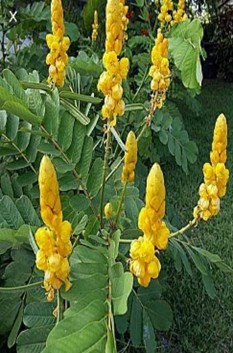
Akapulko is a coarse, erect, branched shrub, 1.5 to 3 meters high. Leaves are pinnate and 40 to 60 centimeters long, with orange rachis on stout branches. Each leaf has 16 to 28 leaflets, 5 to 15 centimeters in length, broad and rounded at the apex, with a small point at the tip. Leaflets gradually increase in size from the base towards the tip of the leaf. Inflorescences are terminal and at the axils of the leaves, in simple or panicled racemes, and 10 to 50 centimeters long. Flowers are yellow, about 4 centimeters inn diameter, at the axils of thin, yellow, oblong, concave bracts which are 2.5 to 3 centimeters long. Pod is rather straight, dark brown or nearly black, about 15 centimeters long and 15 millimeters wide. On both sides of the pods there is a wing that runs the length of the pod. Pod contains 50 to 60 flattened, triangular seeds.
Uses
Intestinal parasitism
Cough
Bronchitis
Asthma
Skin diseases
Fever
Hypertension
Laxative
Insect/snake bites
Diuretic
Purgative
Abortifacient
Cough
Bronchitis
Asthma
Skin diseases
Fever
Hypertension
Laxative
Insect/snake bites
Diuretic
Purgative
Abortifacient
Plant Part Used
Leaves, seeds, and flowers
Distribution
Abundant throughout the Philippines in settled areas at low and medium altitudes, introduced from tropical America; now pantropic.
Preparation
- For external use, pound the leaves of the Akapulko plant, squeeze the juice and apply on affected areas.
- As the expectorant for bronchitis and dyspnoea, drink decoction (soak and boil for 10 to 15 minutes) of Akapulko leaves. The same preparation may be used as a mouthwash, stringent, and wash for eczema.
- As laxative, cut the plant parts (roots, flowers, and the leaves) into a manageable size then prepare a decoction
Note: The decoction looses its potency if not used for a long time. Dispose leftovers after one day.
- The pounded leaves of Akapulko have purgative functions, specifically against ringworms